
Short answer: if the bore is worn but the body is sound, the barrel can usually be re-bored, honed or re-lined. If the body is cracked, the centre distance has moved, or there is not enough wall left for another bore, a new barrel is the honest answer.
Barrel wear is rarely uniform, and the pattern tells you which refurbishment route is viable.
Radial wear in the two lobes. The bore grows away from the centre line, most at the point where the flight tip runs. This is the commonest pattern and the easiest to correct: the geometry is still symmetric, there is simply more clearance than there used to be.
Axial grooving. A band of deeper wear runs along the length of the bore, usually where a hard particle sat and was dragged. Grooving is local rather than general, so it is often worse than the average bore reading suggests. Always measure at several stations, not just at the ends.
Corrosion, cracking and liner breakdown. Corrosive compounds attack the liner surface and the bore intersection; thermal cycling opens cracks at the figure-8 crossing; a badly bonded liner can lift at the edge. These are structural problems, and no amount of re-boring fixes them.
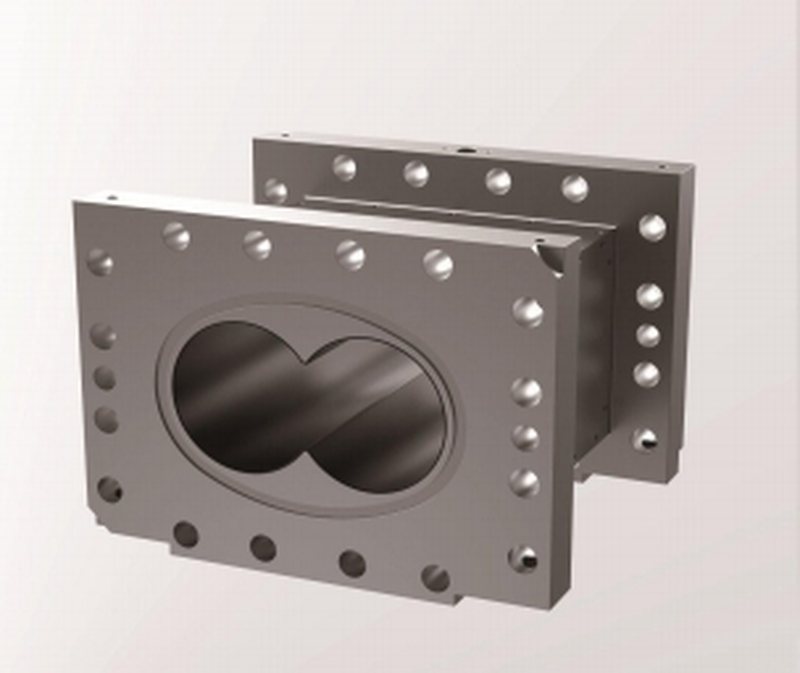
An opinion about a barrel is worth nothing without numbers. Record the following at three or more stations along the length, in both axes of each lobe:
A three-point internal micrometer or a bore gauge is enough for diameter. Centre distance needs either a purpose-made gauge or a CMM reading; a caliper across the outside of the barrel tells you nothing useful.
| Condition | Refurbishment viable? | Typical route |
|---|---|---|
| Bore wear under 0.5 mm on diameter, body sound | Yes | Hone to restore roundness and finish |
| Bore wear 0.5–1.0 mm, wall thickness sufficient | Yes | Re-bore to next oversize, supply matched elements |
| Local grooving deeper than 0.3 mm | Usually | Re-bore past the groove, or weld overlay then re-machine |
| Liner worn but body sound | Yes | Remove old liner, fit new nitrided / bi-metallic / HIP liner |
| Liner lifting or debonded | Yes, if caught early | Re-liner; inspect the body for corrosion underneath |
Honing removes microns, not millimetres. It corrects roundness, removes light scoring and restores the surface finish. It is the cheapest route and the right one when the diameter is still within tolerance but the surface has deteriorated. It cannot correct a bore that has grown.
The figure-8 is machined out to the next standard oversize — commonly +0.25 mm or +0.5 mm on diameter — and the screw elements are supplied with a matching outside diameter. This is the standard fix for general radial wear. The important consequence is that the elements are no longer interchangeable with a standard set, so record the oversize on the barrel and in your maintenance file.
The worn liner is removed and a new one fitted: nitrided for unfilled duty, bi-metallic centrifugally cast for glass-filled, HIP-clad for the most abrasive or corrosive service. Re-lining restores the original nominal bore, which means standard elements fit again. It is the most expensive of the three routes but gives the longest life and keeps your spare-parts standard.
This is where barrel and screw decisions collide, and where most money is wasted. A refurbished bore with a larger diameter needs elements with a matching outside diameter; fitting standard elements into an oversize bore leaves excessive tip clearance, and the line loses conveying efficiency and dispersion quality before the parts have worn at all.
The reverse is equally true: new elements in a worn bore start life with a clearance they should not have. If both are worn, do the work in one shutdown so the supplier can match element diameter to the finished bore. See how to measure screw element wear and clearance for the element side of the same measurement.
| Route | Relative cost | Typical lead time | Restores |
|---|---|---|---|
| Honing | Low | 1–2 weeks | Roundness and surface finish only |
| Re-bore to oversize | Medium | 2–4 weeks, plus matched elements | Geometry, at a new nominal diameter |
| Re-liner | High | 3–5 weeks | Original nominal bore and full wear resistance |
| New barrel section | Highest | 30–45 days for imported-machine sections once material is available and drawings are confirmed | Everything, including the body |
Refurbishment is normally a fraction of the price of a new section, but it is not free money: the section has a finite number of lives, and each one is spent. For a machine on a planned shutdown cycle, the cheapest option over ten years is usually re-lining on schedule rather than running to failure and replacing.
As a working rule, up to about 0.5 mm on diameter can often be corrected by honing, and 0.5 to 1.0 mm by re-boring to the next oversize, provided the wall thickness allows it. The real limit is not the number alone but the clearance it produces against your elements and the effect on product quality.
Usually once, occasionally twice. Each bore removes wall material, and once the thinnest point falls below the design minimum the section is no longer safe to machine. Record every oversize on the barrel so the next person does not have to guess.
In the short term, yes, typically a fraction of the price of a new section. Over a long period the comparison changes, because a refurbished section has a finite number of lives. For planned maintenance, re-lining on schedule usually works out cheaper than running to failure.
Measure both. If the bore has grown but the elements are near nominal, the barrel is the problem. If the elements have lost tip material while the bore is close to nominal, the elements are. If both have moved, replace or refurbish them together so the clearance is correct from the first run.
Yes. Re-boring increases the bore diameter, so the elements must be supplied at a matching outside diameter. Standard elements will fit physically but will run with excessive tip clearance, which costs conveying efficiency and dispersion quality. Re-lining avoids this because it restores the original nominal bore.