
2006
Manufacturing since
30,000 m²
Production site
30+
Countries supplied
Ex-stock
Chinese-machine parts

The shaft carries every newton-metre the drive produces, through a spline that has to stay tight for years. We machine replacement core shafts to the OEM spline form and match them to the element set, so the assembly goes back into the barrel with the right clearance from the first run.
| Spline form | Involute spline to DIN 5480, to OEM drawing |
|---|---|
| Material | 40CrNiMo, H13 or WR15E, selected to your drawing |
| Heat treatment | Nitriding, or induction hardening of the spline |
| Diameter range | 7 – 480 mm, matching our elements and barrels |
| Length | To OEM drawing, single piece or coupled sections |
| Runout | Checked along the full length before shipment |
| Coupling | Torque-limiting coupling or shear pin to OEM arrangement |
| Lead time | Ex stock (Chinese standard machines) 30–45 days (imported-machine spares) |
Chinese standard machines include Giant, Jieya, Chuangbo, Chengmeng, Meizhilong, Jinwei, Useon and Kerke. The 30–45 day figure for imported-machine spares applies once material is available and drawings are confirmed.
Three loads arrive at the same piece of steel at the same time. Torque from the drive, which reverses every time the screws are started against a full barrel. Bending, if the shaft is not perfectly aligned with the barrel bore or if the screw flights are not self-wiping. And fretting, the small oscillating movement between the shaft spline and the element bore that slowly turns a tight fit into a loose one.
Most shafts that fail in service are not broken by overload. They are broken by fatigue that started at a stress concentration nobody looked at — usually the root of the spline, or a change of section where the shaft meets the coupling.
An involute spline to DIN 5480 is defined by the number of teeth, the module, the pressure angle and the fit class. A full designation is enough for us to cut the shaft without seeing the original. If you do not have the designation, the old shaft is a better drawing than most drawings are: we measure tooth thickness, major and minor diameter, and the involute form directly.
Do not assume that two machines of the same model share a spline. Manufacturers changed spline forms across generations of the same series, and a shaft that looks identical can be a few tenths out at the tooth flank.
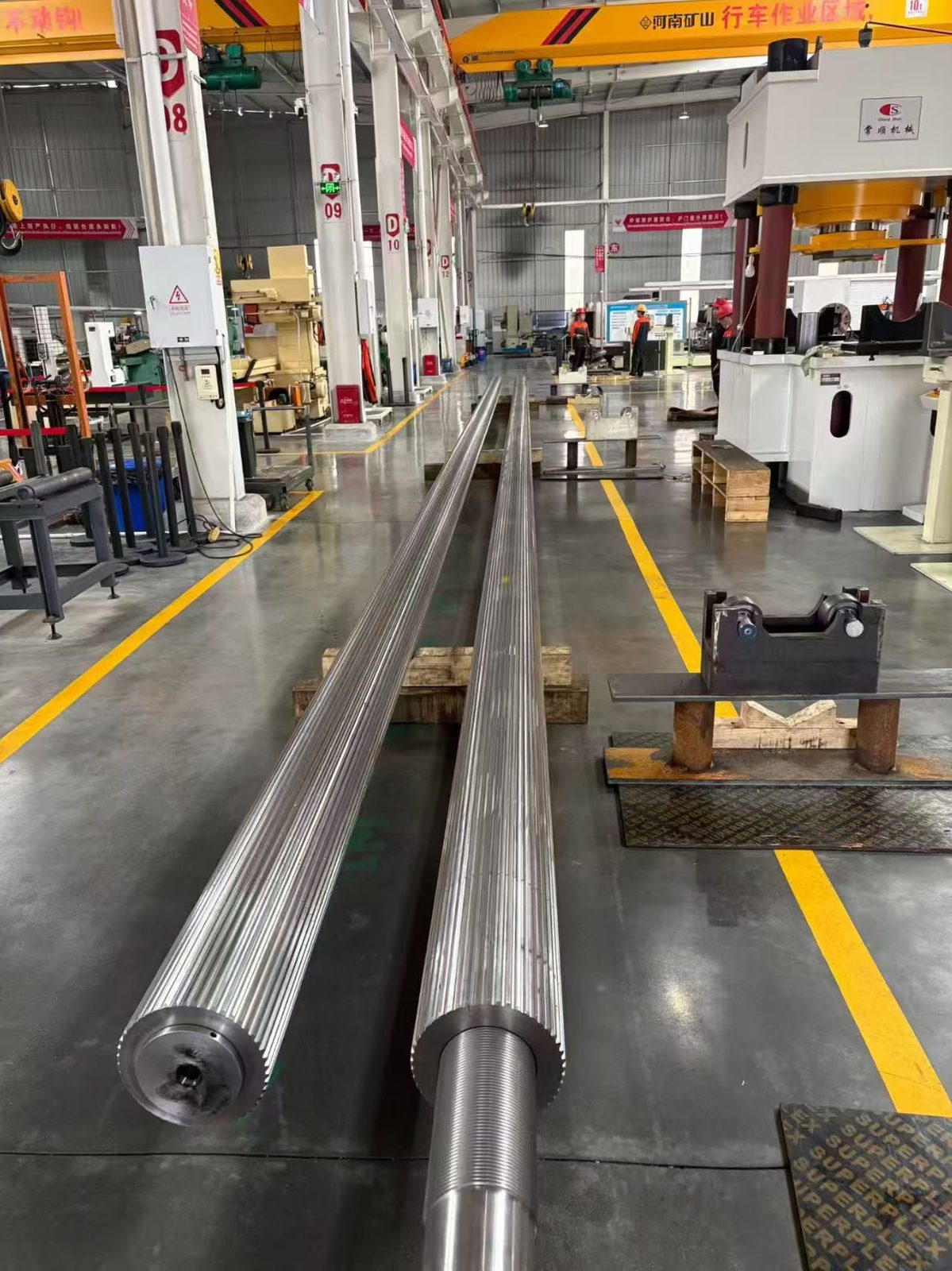
Replacing a full set of elements on a shaft with a worn spline is a waste of the elements: the new set will fret and loosen within months. The decision order is:
Yes. Send the old shaft, or a dimensional sketch with the spline designation, the length, the journal diameters and the coupling arrangement. We measure the spline directly and machine to the measured form. A sample is more reliable than a drawing for older machines, because spline forms changed between generations of the same model.
Not always, but check first. If the spline tooth thickness is within tolerance, the runout is good and there are no cracks at the spline root, the shaft can be reused. If the spline is worn, new elements will fret and loosen within months, so replace both together.
The shaft is the splined core that carries the torque and runs in the bearings. A sleeve, sometimes called a shaft sleeve or an element with a bore, is a wear part that sits on the shaft and can be replaced on its own. Confusing the two is a common reason for ordering the wrong part.
Shafts for Chinese standard machines are normally held in stock and can ship immediately. For imported-machine shafts allow 30 to 45 days once material is available and drawings are confirmed, plus transit. A shaft is usually the longest-lead item in a screw set, so order it first.
Email the spline designation, a photo of the shaft end, or post us the worn part and we will measure it.
Request a quote